

You still can’t buy Cultivated Meat in the UK as of 2 September 2026. That comes down to policy review: no UK sale can happen until regulatory authorities monitor safety and Ministers approve the product.
If I strip the article down to what matters most for you, it’s this:
- Shop shelves: no approval, no retail sale
- Pack wording: labels must make clear what the product is
- Imports: approval abroad does not allow UK sale
- Restaurants: menus have to wait for UK authorisation too
A few dates help put this in context. In July 2025, Gourmey became the first company to have a UK application validated. That meant the review had started, not that sales could begin. The FSA has said it aims to finish safety evaluations by February 2027, but that still would not be the final step.
Elena Walden talks about cultivated meat at UK Parliamentary event.
sbb-itb-c323ed3
Quick comparison
| Area | What policy review decides | What it means for you |
|---|---|---|
| Retail sale | Whether the product can be sold in shops | You can’t buy it until UK approval is in place |
| Labelling | Which words can appear on pack | You should see wording that explains what it is |
| Imports | Whether an overseas product can enter the UK market | US or Singapore approval alone changes nothing here |
| Restaurants | Whether venues can serve it | No legal menu listing before UK authorisation |
What I’d keep in mind is simple: process news is not sale news, and market timelines remain subject to change. A filing, validation, or sandbox place may sound like progress, but it does not mean Cultivated Meat is about to appear in supermarkets or on menus.
Why Policy Reviews Matter Before You Can Buy
In Great Britain, Cultivated Meat can only go on sale after it gets novel food authorisation. The FSA and FSS handle applications together and advise UK Ministers, who make the final call on whether a product can be sold.[12][13]
This review is about more than basic safety checks. The FSA and FSS look at the cell line, the production process, the culture medium, microbiological safety, allergenicity and nutrition compared to traditional meat.[13][14] After reviewing that evidence, they advise UK Ministers on whether the product can be sold.[15][18]
For shoppers, this process shapes both what can be sold and how it appears on the market. It affects label wording and can also shape which product formats are cleared first. A launch can't happen until those terms are listed in the public register of novel food authorisations.[15][16] So the first point where most people will notice any change is simple: when products are allowed to reach shop shelves.
Public trust is a big part of this. Many shoppers want FSA approval in place before they buy Cultivated Meat. In June 2026, FSA tracking found that 43% said Cultivated Meat should not be sold in the UK, 35% supported it, and 22% were unsure.[19] Those figures help explain why clear approval matters so much for consumer confidence.
The process is also starting to move faster. The FSA and FSS are publishing dedicated guidance for Cultivated Meat, and publication rules now allow authorisations to take effect sooner.[3][17] Since April 2025, authorisations have taken effect when the ministerial decision is published, which can cut approval time by up to six months.[20] That timing has a direct effect on when products may show up in shops next.
1. Shop Availability And Retail Launch Timelines
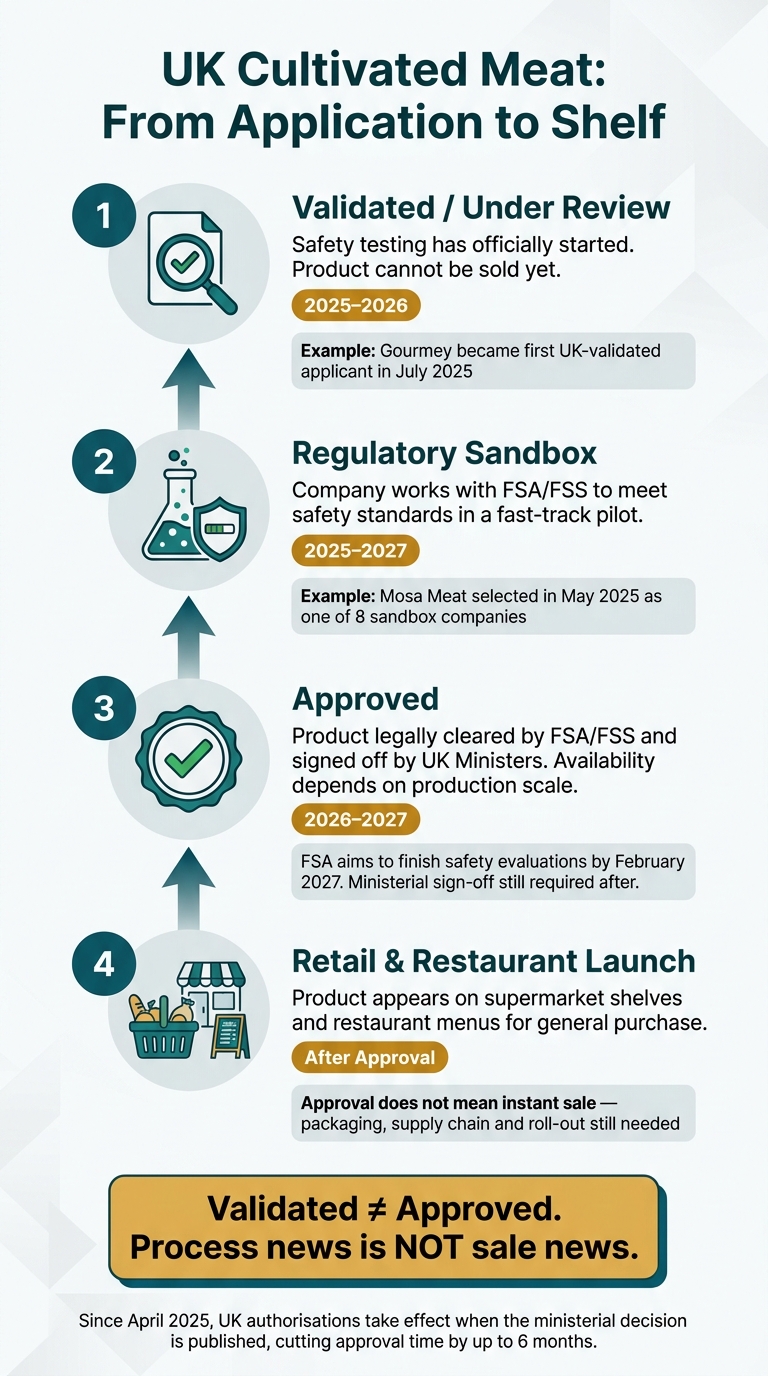
UK Cultivated Meat Approval Process: From Filing to Shelf
Once approval is in place, the next issue is timing: when can Cultivated Meat actually appear on UK shelves?
UK Approval Gate
Cultivated Meat cannot be sold in the UK until the FSA and FSS finish their safety review and Ministers give sign-off. That process can take years, so any supermarket launch is pushed back until those steps are done.
Two milestones in 2025 show where the process stands. In May 2025, Mosa Meat filed for UK approval and was selected as one of eight companies for the FSA's Cell-Cultivated Products Sandbox Programme.[1] Then, in July 2025, Gourmey became the first Cultivated Meat firm to have its application formally validated by both the FSA and FSS, which started its safety review.[2]
The table below shows the usual path to launch, based on current UK estimates.[21][4][22]
| Regulatory Stage | What It Means For Shoppers | Estimated UK Timing |
|---|---|---|
| Validated / Under Review | Safety testing has started; product cannot be sold yet | 2025–2026 |
| Regulatory Sandbox | Company is working with the FSA to meet safety standards | 2025–2027 |
| Approved | Product is legally cleared; availability depends on production scale | 2026–2027 |
| Retail Launch | Product appears on supermarket shelves for general purchase | After approval |
It helps to be clear on the wording here. When a headline says an application has been "validated", that means the assessment has started - not that the product can be sold. "Approved" is the point that opens the door to sale.
The FSA has said it hopes to finish safety evaluations by February 2027, though ministerial sign-off would still need to follow.[4][22] That timeline matters for more than just headlines. Retailers need approval before they can plan shelf space, and a clear decision gives both shops and shoppers a much firmer sense of when launch might happen.
Shelf access is only one part of the picture; policy also affects what brands can print on pack.
2. Product Claims, Labelling And On-Pack Wording
What goes on pack isn't just a marketing call. It's a regulatory one too. A policy review helps decide which words are allowed, which need extra context, and which claims need proof.
UK Regulatory Touchpoint
FSA guidance says the product needs a clear descriptive name. So a pack can't rely on a stand-alone meat term by itself. If there isn't a legal or customary name, UK food labelling law says the wording must explain what the product is. For example, "chicken made from Cultivated Meat cells" rather than just "chicken".[29][30]
Consumer Access Impact And Buying Confidence
These rules shape how easy it is for shoppers to spot Cultivated Meat on pack. Front-of-pack wording plays a big part in whether people recognise the product and feel comfortable buying it. Regulators are still debating whether familiar meat terms can appear on their own or whether they must include Cultivated Meat qualifiers.[8][25][28]
Clear naming can make a first purchase feel less like a leap. UK guidance also confirms that packaging must keep showing core information such as ingredients, allergens and durability details throughout.[11][23]
Headline Relevance
When you see headlines about labelling rules and certifications, that usually means the wording is still being worked through, not that products are about to hit shelves. Claims that suggest parity with conventional meat, overstate green gains, or blur how the product is made are the ones most likely to face checks or limits.[24][26][27]
The FSA can also ask for extra labelling after an initial approval. So on-pack wording can be changed or tightened at any point.[11] That same level of scrutiny can shape whether imported products are ready for sale in the UK.
3. Import Rules And Cross-Border Product Access
For shoppers, the main point is simple: approval overseas does not mean you can buy the product in the UK. Cultivated Meat that is approved and sold in Singapore or the US still needs its own UK authorisation before it can be sold here legally.[31][6][32]
For a product to be imported into the UK, it needs two separate clearances. First, it must get novel food authorisation from the FSA/FSS. After that, animal-origin products must also pass border health checks.[11][7][33]
Consumer Access Impact
UK access to Cultivated Meat may trail other markets - not because the products are not ready, but because the UK carries out its own review.[31][11] So even if a product is already on sale abroad, that does not speed it onto UK shelves by itself.
The flip side is plain enough: any imported Cultivated Meat that does make it into UK shops or onto restaurant menus will have gone through the same scrutiny as a product made here.[7][6] This ensures that regardless of origin, the basics of cultivated meat safety remain the priority.
Headline Relevance
Global momentum is building with overseas launches, but they do not open the UK market. For UK shoppers, the terms that matter most are "validated", "regulatory sandbox" and "UK market authorisation".[2][5][4]
| Headline Term | What It Means for UK Shoppers |
|---|---|
| "FDA Approved" / "Singapore Approved" | Cleared abroad - not yet approved for UK sale |
| "FSA Filing" / "Application Submitted" | Process started, but early stage |
| "FSA Validated" | Safety assessment officially begun in the UK |
| "Regulatory Sandbox" | Company in fast-track pilot with UK regulators |
| "UK Market Authorisation" | Product legally cleared for sale in Great Britain |
If a product clears UK import rules, the next issue is whether it appears in restaurants before it reaches shops.
4. Restaurant Menus And Dining Confidence
For restaurants, policy reviews decide whether Cultivated Meat can move from approval talk to an actual menu item. Until UK novel food authorisation is granted, Cultivated Meat cannot appear on restaurant menus. The FSA and Food Standards Scotland must assess it before it can be sold in restaurants.[10][9][7]
Consumer Access Impact
Any first launch would likely begin in a small number of venues before showing up on more menus. That slow start is pretty normal. Restaurants often test new products in a controlled setting before rolling them out more broadly.
Buying Confidence Effect
Getting onto a menu matters. But diner trust and consumer acceptance matter just as much.
The FSA requires proof that the product is safe, not misleading and nutritionally sound. That carries weight because, in April 2025, 57% of UK adults said they were not willing to include Cultivated Meat in their diet.[34] Official authorisation is the point where a menu mention starts to feel like a credible dining option, not just a talking point.
Headline Relevance
When reading news about Cultivated Meat and restaurants, the line between validation and authorisation matters a lot.
In July 2025, Gourmey became the first Cultivated Meat firm to have its application validated by both the FSA and Food Standards Scotland. That was a meaningful milestone, but it marked the start of the formal assessment, not permission for restaurant use.[2]
Put simply:
- Validation means the review has started.
- Authorisation means the product can be served.
That gap is what decides when Cultivated Meat can move from policy headlines to a restaurant menu.
Next, the article shows what these policy changes mean for shoppers in practice.
What Each Policy Review Changes For Shoppers
In day-to-day terms, these reviews shape when Cultivated Meat gets in front of shoppers and how it is described once it does. Put simply: they affect both access and labelling.
The table below shows what each review changes, and what people are likely to notice in shops or on menus.
| Policy Review Area | What It Changes | What Shoppers Notice |
|---|---|---|
| Shop Availability | Whether a product can be sold at retail | A product appearing in a shop or limited retail launch |
| Product Claims & Labelling | What terms can appear on-pack | Approved wording that clearly identifies the product |
| Import Rules | Whether a product can legally enter the UK | Imported products reaching UK shoppers |
| Restaurant Menus | Whether a venue can legally list Cultivated Meat | Cultivated Meat appearing on select menus |
That said, approval is only one part of the story. Products still need packaging, supply chain planning, and retail roll-out before shoppers can buy them.
So even after authorisation, a product may not show up straight away. Approval does not mean instant sale. Getting from sign-off to launch can still take months. You can stay updated on cultivated meat launches to track these timelines.
How To Read Cultivated Meat Headlines Without The Hype
Reading the headline well is the next useful skill, because not every regulatory milestone means products are ready to buy.
Not every Cultivated Meat story points to a near-term sale. A lot of coverage is about consultations, applications, or sandbox programmes, not approval for products to go on shelves.
The quickest way to size up a story is to check the headline verb, the place, and the regulator named.
The most useful clue is the headline verb. Words like "validated" or "filed" usually mean a review has started, not finished. For example, Gourmey's UK validation marked the start of formal review, not approval for sale.[2]
Place matters as well. Overseas launches may show that the sector is moving ahead, but they do not mean a product is coming to UK shops. It makes more sense to read them as early signs of movement, not signals of British availability. In the same way, bans passed in individual US states do not affect the UK's own path through regulation.
For UK shoppers, the clearest signs of real progress are stories that name the FSA or FSS, point to a specific product or company, and use terms like "authorised" or "approved for sale". By contrast, a story about a sandbox, a public consultation, or a parliamentary debate means the process is moving, not that a product is about to reach the market.
Use the quick guide below to tell process news apart from market access.
| Headline Type | What It Usually Means | Relevance To UK Shoppers |
|---|---|---|
| FSA validation | Safety review has officially started | Important milestone; product still a long way from shelves |
| Approved / authorised | Regulator has cleared a specific product | Closest signal to real availability |
| Regulatory sandbox selected | Company is working through the approval pathway | Progress, but no sale date confirmed |
| Approved overseas | Overseas market clearance only | No direct impact on UK shelves |
| Consultation / parliamentary debate | Regulatory process under discussion | Background context, not near-term access |
| Pilot restaurant launch | Small-scale, venue-specific trial | Early evidence of progress; not national availability |
Where Shoppers Can Keep Track Of Developments
Once you know which headlines matter, the next step is knowing where to look.
For UK developments, check the FSA and FSS for updates on validation, authorisation, and labelling.
Industry reports can add context. But they don't confirm market access.
If you'd rather read a plain-English summary than dig through raw regulatory documents, a consumer guide can help. Cultivated Meat Shop is built for that job. It helps shoppers follow the updates that matter most and register interest for news in one place.
It's also smart to cross-check any bold claim against at least one primary source, such as a regulator or a recognised news outlet, before taking it as confirmed. In practice, regular source-checking is the simplest way to sort real change from noise.
Conclusion
Policy reviews are the gate to market access. They shape when Cultivated Meat can reach UK shelves and menus, what labels can say, which imports can come in, and how much confidence diners feel when they order it. This consumer trust is often built through public awareness campaigns that bridge the gap between policy and plate.
Retail availability, labelling, import access, and restaurant launches all depend on where the FSA review process stands at that moment.
The main point is simple: policy progress is not the same as market access. A clearer path through policy does not mean products are on sale yet. The FSA is aiming to finish safety evaluations in 2027, but ministerial approval would still be needed before sale.[4]
Treat policy updates as access signals, not sale signals. For the clearest picture, check regulator updates, retailer and restaurant announcements, and trusted explainers like Cultivated Meat Shop as the UK market develops. That helps separate process news from products you can actually buy.
FAQs
When could Cultivated Meat go on sale in the UK?
As of September 2026, no Cultivated Meat products have been authorised for human consumption in the UK.
Right now, the Food Standards Agency is reviewing applications through its regulatory sandbox. Based on expert views, the first products could reach the market by March 2027.
The launch probably won’t happen all at once. Instead, Cultivated Meat is expected to show up first in a small number of restaurants before it makes its way onto supermarket shelves.
What does “validated” mean?
Here, validated means the regulator - in the UK, the Food Standards Agency and Food Standards Scotland - has checked the application and confirmed it can move into the formal assessment process for safety and standards.
It does not mean approval yet. It means the application has been accepted for review, rather than rejected or left unassessed.
Will imported Cultivated Meat need UK approval?
Yes. Imported cultivated meat must be approved by the Food Standards Agency and Food Standards Scotland before it can be sold in the UK.
Approval in another country does not mean it can go on sale here automatically. Imported products have to meet the same safety, quality and production standards as cultivated meat made in the UK.


