

If you want to know when cultivated meat may get cheaper and reach shelves, look at its university partnerships.
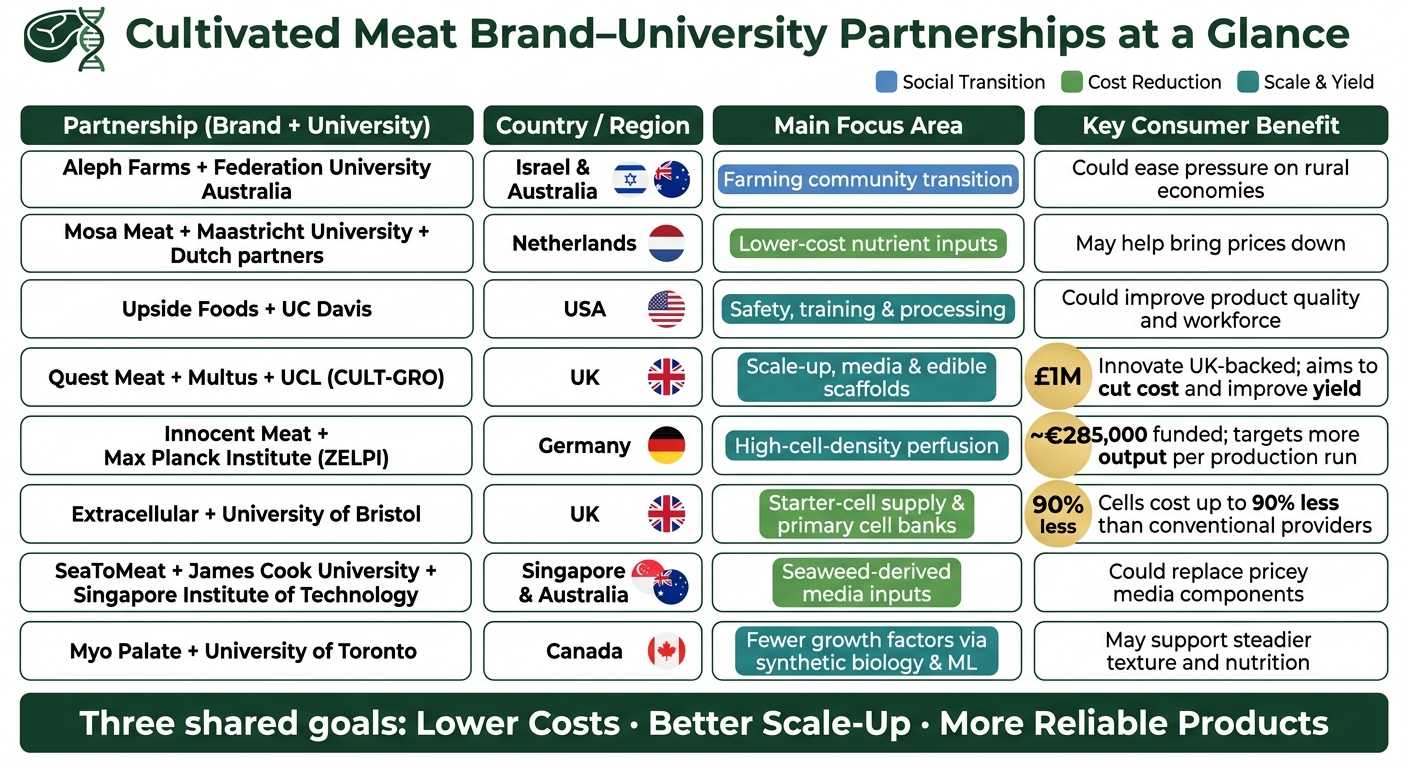
From what I can see, these deals focus on three things: cutting media costs, improving scale-up, and building safer, steadier production. Recent examples span Israel, Australia, the Netherlands, the UK, Germany, Canada, Singapore, and the US, with named projects ranging from £1 million in UK-backed R&D to about €285,000 in German public funding.
Here’s the short version:
- Aleph Farms + Federation University Australia look at how cultivated meat could fit with farming communities.
- Mosa Meat + Maastricht University + Dutch partners work on cheaper nutrient inputs.
- Upside Foods + UC Davis back research and specialist training.
- Quest Meat + Multus + UCL target lower-cost scale-up through the CULT-GRO platform.
- Innocent Meat + Max Planck Institute work on higher cell yields using perfusion methods.
- Extracellular + University of Bristol launched primary cell banks said to cost up to 90% less than standard provider cells.
- SeaToMeat looks at seaweed-based inputs to replace parts of growth media.
- Myo Palate + University of Toronto work on stem cells that use fewer growth factors.
For me, the main takeaway is simple: these university links are less about headlines and more about solving the bottlenecks that affect price, supply, taste, and safety.
Cultivated Meat University Partnerships: Goals, Funding & Impact
Tufts University Center for Cellular Agriculturewith Meera Zassenhaus of Tufts University
sbb-itb-c323ed3
Quick Comparison
| Partnership | Main focus | Why it matters to shoppers |
|---|---|---|
| Aleph Farms + Federation University Australia | Farming transition | Could ease pressure on rural economies |
| Mosa Meat + Maastricht University + partners | Lower-cost nutrient inputs | May help bring prices down |
| Upside Foods + UC Davis | Safety, training, processing | Could improve product quality and staffing |
| Quest Meat + Multus + UCL | Scale-up, media, edible scaffolds | Aims to cut cost and improve yield |
| Innocent Meat + Max Planck Institute | High-cell-density perfusion | Targets more output from production runs |
| Extracellular + University of Bristol | Starter-cell supply | Lower-cost cell banks may reduce inputs |
| SeaToMeat | Seaweed-derived media inputs | Could replace pricey media components |
| Myo Palate + University of Toronto | Fewer growth factors | May support steadier texture and nutrition |
Put simply, I’d read these partnerships as a sign of where the sector is putting its money and time: cost down, output up, and product quality under tighter control.
Cultivated Meat brand-university partnerships active today
These partnerships cover three big areas: social transition, cost reduction, and specialist training.
Aleph Farms and Federation University Australia
Aleph Farms, the Israeli Cultivated Meat company, has partnered with Federation University Australia to look at how Cultivated Meat could work alongside farming, not push it aside. The aim is to support rural communities, protect farmers’ economic security, and develop business models for livestock-based food systems that are sustainable and inclusive [3].
That point matters. It shapes how fast Cultivated Meat can grow without adding strain to rural areas.
In plain terms, this partnership presents Cultivated Meat as part of a managed shift for farming communities, not a sudden swap.
Mosa Meat, Maastricht University and Dutch research partners
Other partnerships are less focused on farming transition and more focused on bringing production costs down.
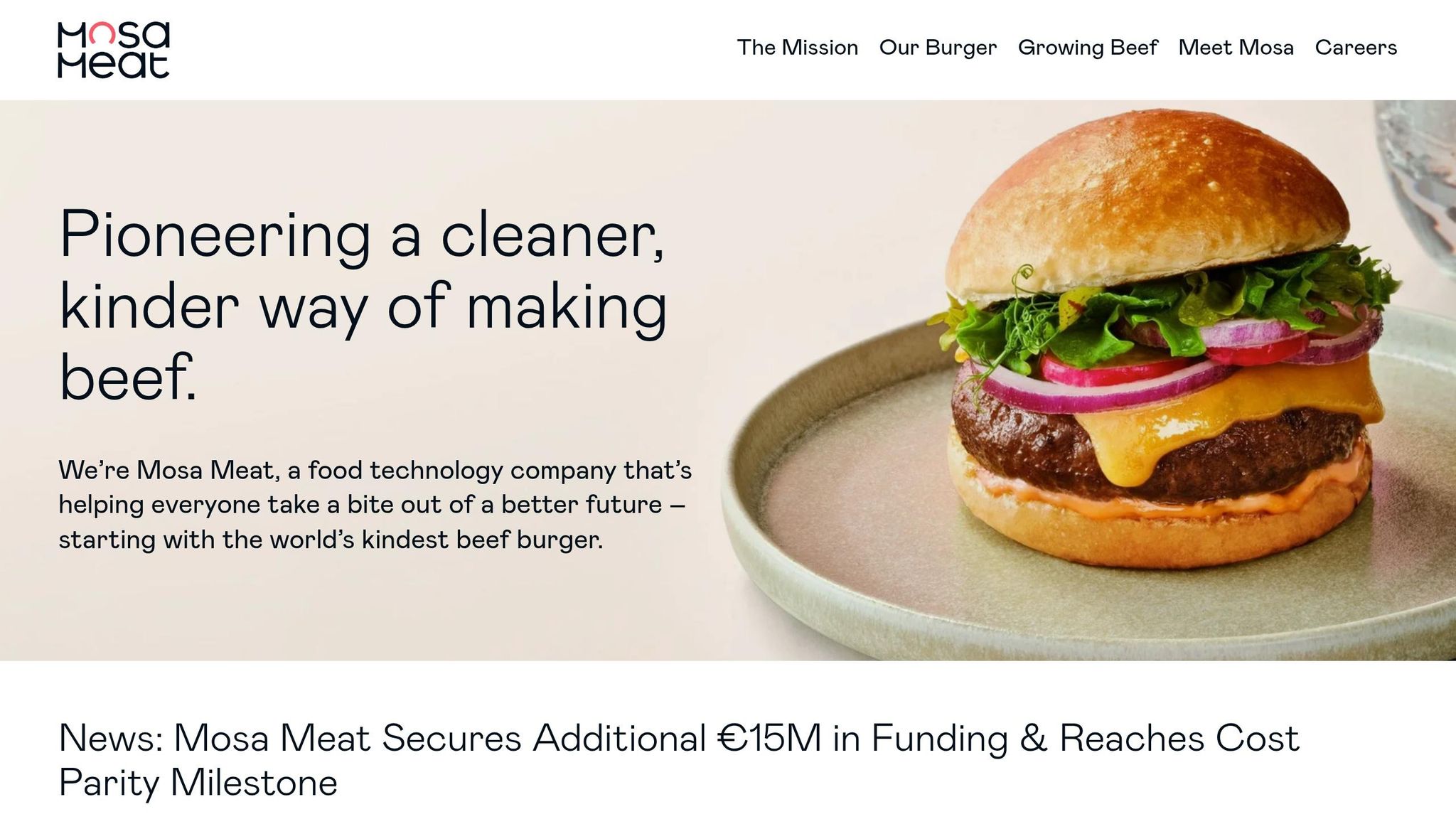
Mosa Meat is working with Maastricht University, Nutreco and Brightlands Campus Greenport Venlo through the Feed for Meat project to develop cheaper, more stable nutrient inputs for cell cultivation. The project is centred on cheaper, more stable nutrient inputs for cell cultivation, which could help lower future prices.
If it works, future products should become less expensive and their pricing should be more predictable.
Upside Foods and the UC Davis Cultivated Meat Consortium
A third area of university collaboration focuses on safety, research training and scale-up know-how.
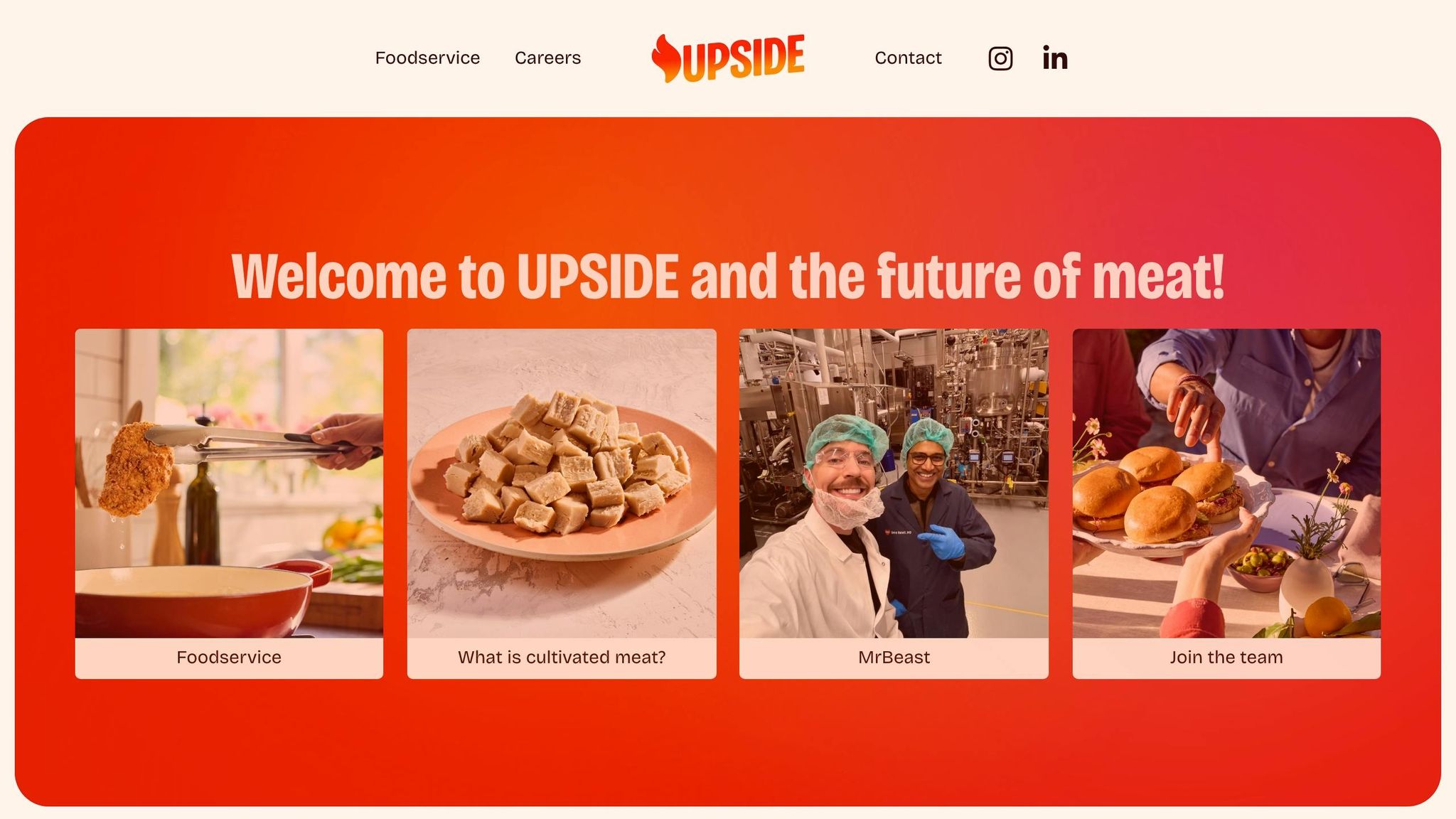
Upside Foods supports the UC Davis Cultivated Meat Consortium at the University of California, Davis. The consortium brings together scientists working across cell biology, food safety and processing methods, with a focus on training future specialists in the field.
That support also helps build the specialist workforce the industry needs.
UK and European collaborations worth watching
Quest Meat, Multus and University College London
In January 2024, Quest Meat, Multus and UCL launched a £1 million Innovate UK-backed R&D partnership. The project focuses on CULT-GRO, a platform that combines nutrients with edible scaffolding for cell growth. The goal is simple: make industrial-scale Cultivated Meat production possible at a lower cost [4].
UCL’s job is to test the platform in industrial bioreactors and verify that it performs at commercial scale. Quest Meat provides edible microcarriers and primary cell banks. Multus develops serum-free growth media. UCL then tests the full system in bioreactors [4][5]. Put together, the partnership goes straight at the two big pain points in the sector: production cost and yield. Those are the issues most likely to decide when Cultivated Meat becomes commercially viable.
Other emerging collaborations in Europe and beyond
Similar university partnerships are now working on yield, scale-up and cell line longevity across Europe.
In January 2026, German startup Innocent Meat teamed up with the Max Planck Institute for Dynamics of Complex Technical Systems on the ZELPI project. Led by Professor Dr. Yvonne Genzel and backed by about €285,000 from Germany's Federal Ministry for Economic Affairs and Energy, the project uses high-cell-density perfusion techniques adapted from vaccine manufacturing to push cell yields towards industrial levels [2].
Then, in June 2023, UK CDMO Extracellular worked with the University of Bristol's Veterinary School to launch licence-free primary cell banks from cows, pigs and lambs. The project was funded by Innovate UK, and the cells reportedly cost up to 90% less than conventional provider cells [6].
For shoppers, this isn’t just lab talk. Each project is trying to fix the bottlenecks that affect price, availability and product quality. That means these partnerships could play a big part in shaping what ends up on shelves, and what people end up paying for it.
What these partnerships could mean for consumers
Lower costs, stronger trust and better product quality
These partnerships matter most when they start cutting costs and making production more reliable. In June 2025, James Cook University and the Singapore Institute of Technology launched the SeaToMeat project, which uses enzymatic hydrolysis to turn seaweed into seaweed-derived protein ingredients that could replace conventional growth media [1].
That kind of work does more than trim production costs. When universities test these ingredients and manufacturing methods on their own, they produce evidence that regulators and cautious shoppers can lean on. It ties lab research to buyer confidence and regulatory acceptance. It also checks whether sustainability claims hold up in actual production [1].
The same kind of research can also shape what ends up on the plate. In a project with Myo Palate, Professor Michael Garton at the University of Toronto used synthetic biology and machine learning to design stem cells that need fewer expensive growth factors [7]. Cut those inputs, and production can become more consistent. That can lead to steadier texture and nutrition too [7].
Why UK shoppers should follow these developments
For shoppers, the takeaway is pretty simple: better research should lead to lower prices, steadier supply and higher-quality products. For UK shoppers, these partnerships will help decide how fast Cultivated Meat reaches shelves and what it will cost.
Conclusion: Key takeaways from Cultivated Meat brand-university partnerships
These partnerships are pushing on the same three pressure points: lower costs, better scale-up, and more reliable products. That’s where the battle is. Whether it’s replacing pricey growth media, using vaccine-scale bioprocessing in food production, building up starter-cell supply, or improving sensory quality, the work in this roundup goes straight at the issues most likely to decide when Cultivated Meat becomes commercially viable.
For shoppers, the payoff is simple: faster movement towards products that are cheaper, safer, and more appealing. These partnerships will shape how soon Cultivated Meat lands on shelves, and how much people will pay when it does.
FAQs
Why are universities important to Cultivated Meat brands?
Universities are important partners for Cultivated Meat brands because they bring specialist know-how in stem cell biology, muscle physiology and bioprocessing engineering.
They also give companies access to advanced facilities and bioreactors. That can help cut infrastructure costs and take on tough technical problems, such as developing affordable, serum-free growth media and improving cell lines for industrial output.
Which partnerships are most likely to cut prices first?
Partnerships aimed at replacing pricey animal-based inputs like fetal bovine serum, or making growth media cheaper, are the ones most likely to bring prices down first.
You can already see this in a few examples. James Cook University and the Singapore Institute of Technology are working on seaweed-based proteins. ClearMeat and NIFTEM-K are focused on serum-free growth media. And Immobazyme, working with the CSIR, has already commercialised a key growth factor at a much lower price.
How could these projects affect when Cultivated Meat reaches UK shops?
These university partnerships could help Cultivated Meat reach UK shops sooner by tackling two big hurdles: cost and scale.
Right now, those are the sticking points. It’s one thing to grow meat in a lab. It’s another to do it at factory level, at a price that works for producers, retailers, and shoppers.
That’s where these partnerships come in. By working on lower-cost food-grade ingredients and better bioprocessing and bioreactor performance, universities can help make large-scale production more practical. And if production gets easier to scale, overall costs can start to come down too.
If you want to keep an eye on how this space is moving, you can follow these developments at Cultivated Meat Shop.


