

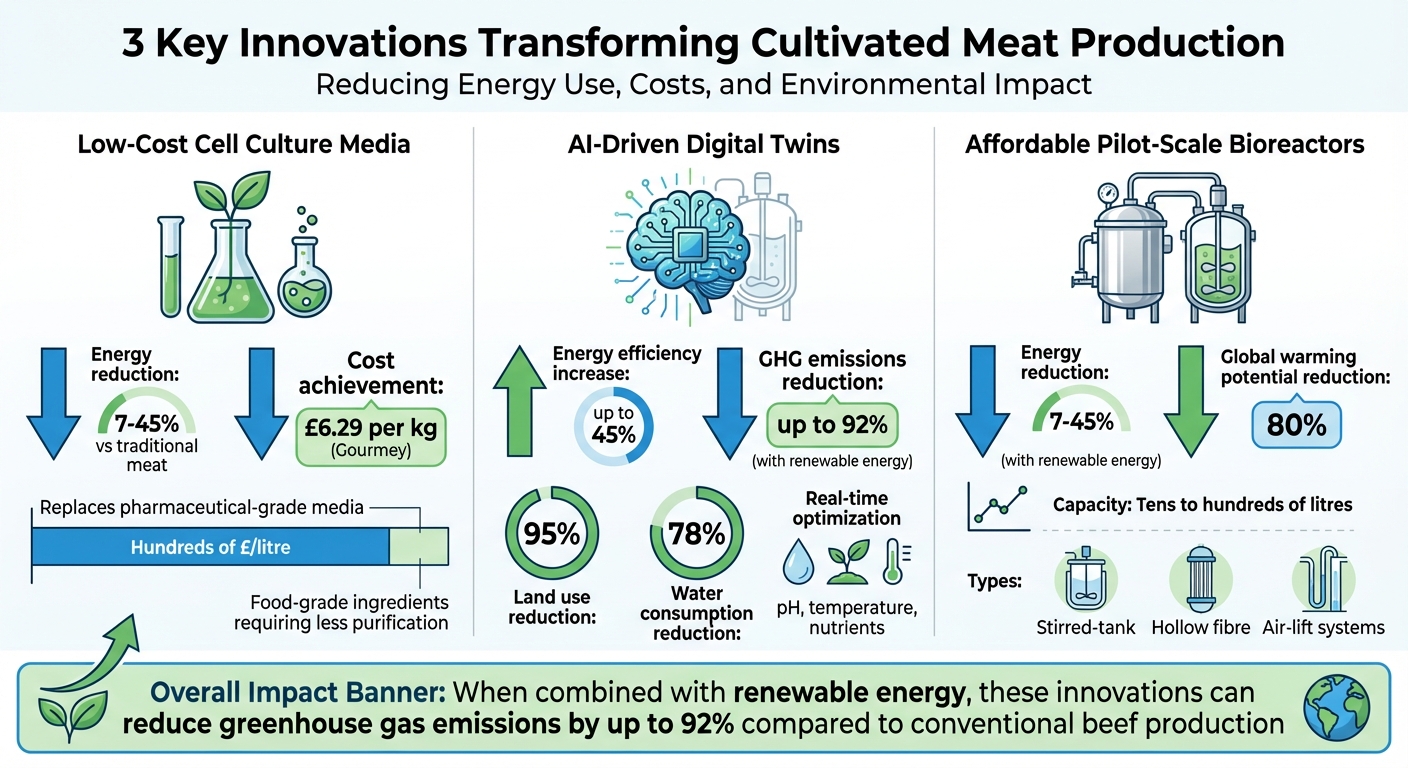
Cultivated Meat offers a cleaner alternative to traditional livestock farming, potentially cutting greenhouse gas emissions by up to 92% when powered by renewable energy. However, its high energy demands have been a challenge. Recent advancements are addressing this issue, making production more efficient and affordable. Here are three key developments transforming the industry:
- Low-cost cell culture media: Switching to simpler, food-grade ingredients reduces costs and energy use.
- AI-driven digital twins: Virtual models optimise production, cutting energy waste by up to 45%.
- Affordable pilot-scale bioreactors: Scalable systems improve nutrient recycling and reduce energy needs.
These innovations are making Cultivated Meat more accessible and efficient, edging it closer to supermarket shelves. Let’s explore how each of these advancements works.
3 Key Innovations Making Cultivated Meat Energy-Efficient: Cost and Energy Savings Comparison
CE Delft | LCA of cultivated meat production in 2030
sbb-itb-c323ed3
1. Low-Cost Cell Culture Media
Cell culture media, the nutrient-rich liquid that supports the growth of animal cells, has been a significant expense in producing Cultivated Meat. Pharmaceutical-grade media can cost hundreds of pounds per litre, making it a costly hurdle for the industry. However, switching to low-cost, simplified alternatives is changing the game. These alternatives not only reduce costs but also cut down on energy losses tied to the purification and processing of high-grade ingredients.
Energy Savings Potential
Low-cost media formulations have the added benefit of reducing energy consumption. Unlike pharmaceutical-grade media, which requires energy-intensive purification, these alternatives simplify the process. Research from Oxford University shows that using options like cyanobacteria hydrolysate can reduce energy use by 7–45% compared to traditional meat production (beef, sheep, or pork) when scaled to a 1,000kg output [3][5]. This is largely due to streamlined media production and more efficient bioreactor operations, making large-scale production more energy-efficient.
Scalability for Commercial Production
The industry is quickly moving away from costly fetal bovine serum (FBS) and adopting plant-based, serum-free alternatives that are more commercially sustainable. In 2026, Clever Carnivore, a U.S.-based company, highlighted its development of low-cost, limited-ingredient cell culture media as one of three major scientific breakthroughs enabling affordable, scalable cultivated pork production [8].
Cost-Effectiveness in Cultivated Meat Processes
Companies are already demonstrating how these advancements can bring costs down. Gourmey, for instance, has optimised its media and bioprocessing to achieve costs as low as £6.29 per kilogram (€7 per kilogram), bringing cultivated meat closer to price parity with conventional meat [8]. Similarly, Vow has developed in-house media formulations that drastically reduce costs from hundreds of pounds per litre, making commercial production a reality [4].
These cost reductions do more than just make cultivated meat affordable - they also enhance energy efficiency and reduce environmental impacts. Hanna Tuomisto of Oxford University emphasises that low-cost media significantly lowers the environmental footprint of Cultivated Meat, making it a viable option to feed a growing global population [3]. These advancements mark a critical step forward as the industry continues to tackle production challenges.
2. AI-Driven Digital Twins for Cell Optimisation
AI-driven digital twins act as virtual replicas of bioreactors, enabling the simulation and fine-tuning of production conditions without the need for expensive physical trials [12]. These models can forecast cell growth, nutrient consumption, and shifts in environmental factors like pH and metabolite levels throughout the production process [12]. By leveraging real-time sensor data, digital twins dynamically adjust parameters such as stirring, heating, and media flow to boost efficiency and minimise waste [4][6]. This level of optimisation paves the way for energy savings during large-scale production.
Energy Savings Potential
With precise control, energy efficiency can increase by as much as 45%, avoiding unnecessary heating and agitation [5][6]. When combined with renewable energy sources, cultivated meat produced through these optimised processes has the potential to reduce greenhouse gas emissions by up to 92%, land use by 95%, and water consumption by 78% compared to conventional beef production [11][12].
Scalability for Commercial Production
Digital twins also play a critical role in scaling up production for commercial use. They simulate fluid dynamics, scaffold designs, and harvesting strategies to support the development of high-density cell cultures [10][12]. Computational modelling helps identify the best scaffold materials, shapes, and surface textures for bioreactors, improving cell attachment and growth efficiency [12]. These energy savings not only lower costs but also make scaling up more feasible. This technology allows for the creation of customised bioreactor designs tailored to the specific needs of cultivated meat, particularly for anchorage-dependent cells, without the financial burden of trial-and-error prototyping [12].
Cost-Effectiveness in Cultivated Meat Processes
By reducing reliance on physical experiments, digital twins significantly cut development time and energy demands.
Nicholas Chilton from Vow highlights the value of refining in-house media formulations through modelling to enhance energy efficiency [4].
Dr John Lynch underscores that the efficiency of culture processes hinges on such technologies, particularly when paired with decarbonised energy systems, to achieve low-carbon outcomes [9].
3. Affordable Pilot-Scale Bioreactors
Building on cost-effective media and improved cell growth, pilot-scale bioreactors bring a new level of efficiency to Cultivated Meat production. These systems, typically holding tens to hundreds of litres, make scalable production possible while keeping energy costs low. By borrowing design principles from the pharmaceutical sector, companies can test and fine-tune production methods before investing in larger facilities [12][15].
Energy Savings Potential
When powered by renewable energy, pilot-scale bioreactors can cut energy use by 7–45%, aligning with efficiency gains observed in other technological advancements [6]. These systems allow precise control over nutrients, oxygen levels, pH, and biomass, which helps to reduce energy waste [6][7]. As the industry progresses, these savings are expected to grow further. Adopting these "pharma to food" approaches is a key step toward achieving an 80% reduction in global warming potential [13]. This shift directly tackles the energy challenges that have historically limited the environmental benefits of Cultivated Meat.
Scalability for Commercial Production
Stirred-tank reactors (STR) are a popular choice for handling microcarriers, although computational fluid dynamics (CFD) simulations have highlighted challenges like oxygen gradients and shear stress at the 200-litre scale [6][15]. Hollow fibre bioreactors, used by Upside Foods (formerly Memphis Meats), excel at delivering nutrients and oxygen to cell cultures [6]. On the other hand, air-lift bioreactors offer lower shear stress, making them better suited for mammalian cells in Cultivated Meat production [15].
In 2023, Aleph Farms introduced a modified bioreactor system designed to simplify the production of whole-cut beef. This two-step system lowers both costs and energy requirements [14]. By enabling efficient and scalable production, these designs pave the way for affordable experimentation, which is critical for making Cultivated Meat commercially viable.
Cost-Effectiveness in Cultivated Meat Processes
Pilot-scale systems provide an affordable way to optimise processes without requiring massive upfront investments. For example, researchers at University College London created scaffolds from leftover brewing yeast, showcasing how innovative experimentation can uncover cost-saving materials that still support scalability [7]. Combining these cost reductions with energy efficiency gains helps address the production hurdles that have slowed the path to commercial-scale Cultivated Meat.
Nicholas Chilton from Vow highlights the importance of vertical production, scaling, and in-house media development for reducing energy costs in bioreactors [4].
How These Technologies Address Production Challenges
These advancements tackle some of the biggest hurdles in Cultivated Meat production: high energy demands, limited scalability, and prohibitive costs. For instance, low-cost cell culture media and affordable pilot-scale bioreactors help cut production expenses while allowing processes to be fine-tuned before transitioning to industrial-scale systems. AI-powered digital twins add another layer of efficiency by simulating and optimising growth conditions.
Refining cell growth protocols and improving bioreactor designs also play a role in reducing energy consumption and lowering carbon emissions, making the production process more environmentally friendly.
Pilot-scale systems serve as a crucial link between laboratory research and full-scale industrial production. They minimise financial risks by enabling gradual improvements and testing on a smaller scale. When combined with cost-effective culture media and optimised protocols, these systems enhance the economic viability of producing Cultivated Meat at volumes that can compete with traditional meat.
By integrating cheaper materials, streamlined processes, and scalable equipment, these innovations bring Cultivated Meat closer to achieving price parity with conventional meat. This is essential, as consumers are unlikely to embrace Cultivated Meat if it remains significantly more expensive than the options currently available in supermarkets. These advancements make production more practical and affordable, moving Cultivated Meat closer to becoming a familiar sight on British dinner tables.
Together, these solutions address the main production challenges and lay the groundwork for Cultivated Meat to enter the mainstream market.
What's Next for Energy-Efficient Cultivation
Government backing and collaboration within the industry are key to advancing energy-efficient Cultivated Meat production. Public funding plays a crucial role in supporting research into advanced systems like circular nutrient recycling and photosynthetic media components [2]. National cell line repositories in countries such as Singapore, the United States, Brazil, and India are easing the resource demands on individual companies. This allows these businesses to focus on improving production efficiency and overcoming industry challenges [1]. With this kind of support, we can expect further progress to complement the energy-efficient methods already in development, creating a well-rounded approach to sustainable Cultivated Meat production.
Take Japan's Moonshot Programme as an example. In 2023 and 2024, the National Agricultural and Food Research Organisation funded a project involving Professor Tatsuya Shimizu of Tokyo Women's Medical University, Kobe University, and IntegriCulture Inc. This collaboration led to the creation of a circular cell culture system using microalgae to recycle spent media. By incorporating the L-lactate dehydrogenase gene from E. coli into Synechococcus microalgae, the team successfully converted waste lactate back into glucose, allowing the media to be reused multiple times. This innovation boosted cell growth by four times within just three days [2].
Integrating renewable energy will be essential for scaling such breakthroughs. The industry, which now includes over 140 companies spread across six continents and backed by more than £2.7 billion in investments, is shifting towards food-grade media components. These components require less energy-intensive purification compared to pharmaceutical-grade alternatives [1].
Consumer platforms like Cultivated Meat Shop also play a pivotal role in bridging the gap between technical advancements and public awareness. By offering straightforward and accessible details about energy-efficient production methods, these platforms help prepare British consumers for the arrival of affordable and eco-friendly Cultivated Meat products in supermarkets.
FAQs
How soon could cultivated meat reach UK supermarkets at competitive prices?
Cultivated meat might hit UK supermarket shelves at competitive prices by the early 2030s. Improvements in scaling up production, boosting efficiency, and cutting costs are expected to bring its price closer to that of traditional meat. These developments are crucial for making cultivated meat a more affordable option for consumers.
What makes low-cost, food-grade culture media more energy-efficient?
Low-cost, food-grade culture media offer a more energy-efficient solution by substituting expensive pharmaceutical-grade components with budget-friendly, scalable food-grade alternatives. This change not only cuts production costs but also lowers resource use, making the process far more efficient and environmentally friendly.
How do AI digital twins reduce bioreactor energy use in real time?
AI-powered digital twins offer virtual replicas of bioreactors, allowing for simulations of key factors such as fluid dynamics, nutrient distribution, and cell growth. By using these simulations, producers can make predictive adjustments to fine-tune conditions, ultimately boosting efficiency and reducing waste. This real-time fine-tuning also plays a major role in cutting down energy usage during the production of cultivated meat.


